Project Areas
RESCUE’s work is organised into six Project Areas — three enabling technology tracks and three application domains — each with dedicated demonstrators in real-world environments.
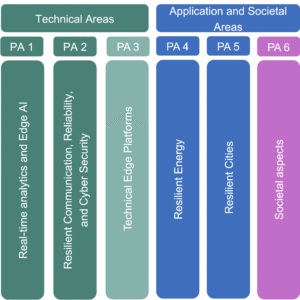
RESCUE organises its work into six Project Areas. Three are enabling technology tracks that develop the core components — Edge AI, communications, and distributed platforms. Three are application and societal areas that deploy and validate those technologies in real-world energy and urban environments.
Enabling Technology Areas
These three technical areas develop the foundational components that power all RESCUE applications.
Real-Time Analysis and Edge AI
As smart energy systems and cities generate vast amounts of sensor and IoT data, processing it at the edge — closer to the source — is essential for fast, autonomous response. PA 1 advances real-time anomaly detection using Edge AI, enabling infrastructure systems to identify and respond to incidents without cloud dependency.
Key innovations include federated machine learning across distributed edge nodes, adaptive algorithms for continuous monitoring, and autonomous decision-making for both energy grids and urban environments.
Communication, Reliability, and Cybersecurity
Secure, uninterrupted data flow is the backbone of resilient infrastructure. PA 2 develops a modular IoT connectivity management platform integrating multiple communication channels — cellular, satellite, LoRaWAN, and more — with a unified authentication and profile management system.
The cybersecurity component introduces continuous threat monitoring and vulnerability assessment, advancing beyond traditional static security frameworks to provide adaptive, proactive protection for critical infrastructure networks.
Technical Edge Platforms
PA 3 develops the scalable middleware that ties together the RESCUE system — enabling interoperability between edge devices and cloud services, managing distributed federated AI models, and ensuring the platform remains operational even when parts of the infrastructure are down or compromised.
This includes standardised APIs, data model frameworks, and the distributed architecture needed for mission-critical applications to continue running during disruptions.
Application and Societal Areas
These areas deploy and validate RESCUE technologies in real energy and urban environments, and ensure solutions are societally accepted and user-centred.
Resilient Energy
Energy systems are increasingly distributed, with Distributed Energy Resources (DERs), local flexibility markets, and peer-to-peer energy trading changing how grids operate. PA 4 enhances energy resilience through blockchain-based P2P trading, precise time synchronisation protocols (PTP/White Rabbit), and real-time edge intelligence for grid stability management.
Demonstrators are deployed at real energy infrastructure sites, validating RESCUE technologies under operational conditions.
Resilient Cities
Urban environments are complex, multi-stakeholder systems where interoperability and privacy are critical. PA 5 advances resilient city frameworks using the Yggio platform (Zero Trust Architecture), standardised data-sharing protocols (NGSI-LD/FIWARE), and digital twins for proactive incident management.
The area specifically addresses the urban digital divide and ensures that resilience technologies are equitable, GDPR-compliant, and aligned with municipal operational realities. Demonstrators run in Gothenburg and Stockholm.
User Acceptance and Societal Integration
Technology is only as effective as its adoption. PA 6 ensures that RESCUE’s solutions are user-centred, trustworthy, and accepted by the operators, municipalities, and citizens who depend on them. This includes human factors research, usability evaluation, and societal acceptance studies across the project’s demonstrator sites.
PA 6 also coordinates regulatory alignment and engagement with standards bodies to ensure that RESCUE’s outputs can be adopted at scale across Europe.

This project has received funding from the European Union’s Horizon Europe research and innovation programme under grant agreement No. 101225910. Swiss participants are funded by the Swiss State Secretariat for Education, Research and Innovation (SERI).